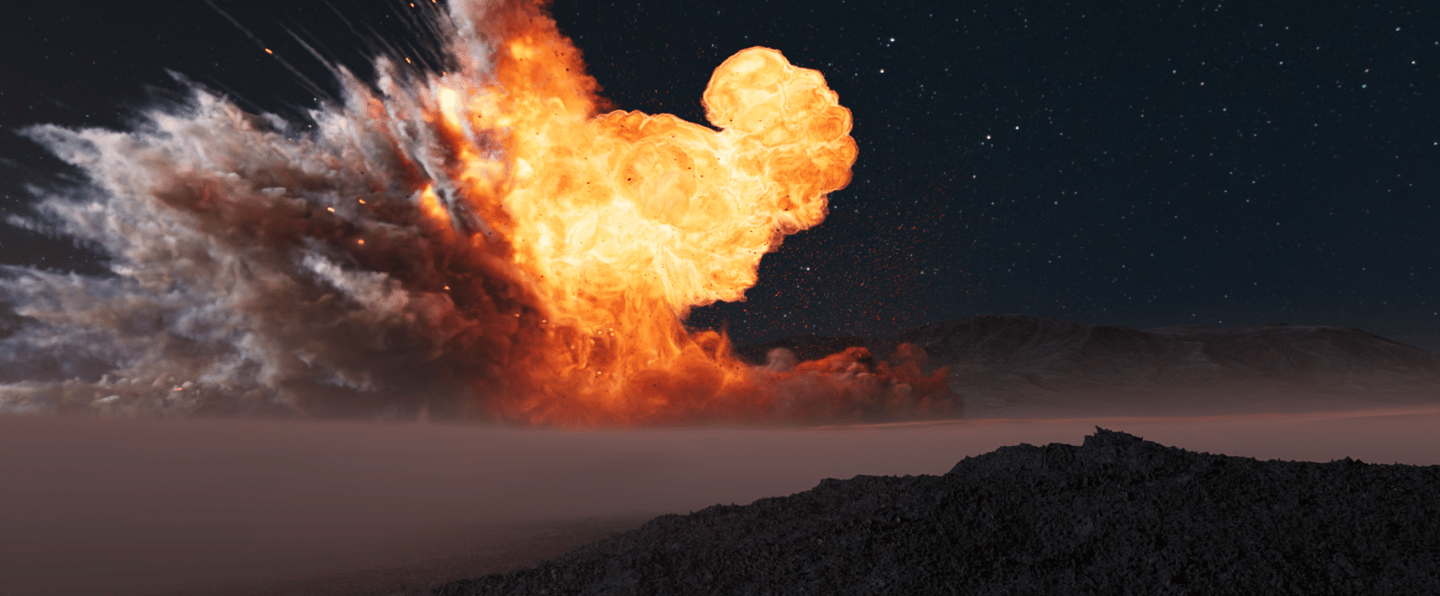
meteor impact

MA final Project
Problem
Achieving a large-scale, physically believable meteor impact in Houdini presents significant challenges in both destruction and volumetric effects. The core difficulty lies in accurately simulating how solid materials fracture, eject debris, and interact with layered smoke and dust at the moment of impact. Traditional rigid-body or particle-based workflows often struggle to retain internal stress detail and volume-preserving deformation, resulting in unrealistic breakup behavior.
This project focuses on leveraging the Material Point Method (MPM) to simulate dynamic destruction with high-fidelity debris motion and material response. A key objective is to seamlessly integrate these simulations with multiple volumetric systems—including shockwaves, fire, and dust layers—to achieve cohesive interaction during and after the meteor collision.
Approach
The core approach of this project is to drive the visual impact through dynamic destruction and multi-layered pyro simulations, all triggered by the meteor’s collision with the terrain. Debris motion, crater formation, and force propagation are used as the foundation for generating explosion behavior, ensuring that all elements remain physically connected to the event.
Initially, pyro and dust elements were generated independently, which resulted in disconnected motion. The workflow was refined by using debris velocity and impact timing to control shockwave expansion, fireball growth, and secondary dust emissions. This creates a streamlined relationship where the destruction directly dictates the explosive effects, enabling stronger cohesion and more believable large-scale results.
Method
Early development explored multiple approaches to simulate the meteor impact and debris motion; however, initial destruction methods did not produce convincing fragmentation or interaction with pyro effects. To improve realism, a unified workflow was developed where destruction, shockwave, and layered smoke simulations are driven directly by the impact event and debris forces.
The simulation process incorporates dynamic destruction when the meteor strikes the terrain, generating debris that influences fire expansion and ground dust emission. Multiple volumetric passes were then created to form a visually complex explosion with clear layering and force direction.


REnder